Fast, reliable image writing for Windows. Create bootable USB and SD cards from .img and .iso files with byte-level verification, clean logs, and safe device detection—built for Windows 11/10.
- Write & verify images (optional SHA-256 check)
- Read-back to file for backups and audits
- Portable 64-bit build • no ads • no telemetry
- Clear logs for troubleshooting and support
Key Features of Win32 Disk Imager
Write RAW Images
Quickly write raw disk images (.img, .iso, .bin) to USB drives or SD cards while preserving boot sectors and partition layout—ideal for Raspberry Pi, Steam Deck and firmware recovery tasks.
Read‑Back & Backup
Create byte‑perfect clones of removable media back into an image file. Save a snapshot before experimenting or archive a working card so you can restore it later in seconds.
Verify Image
After writing, the Verify pass re‑reads the device and compares every byte against the source file, catching hidden write errors from flaky cables or aging flash cells—before you try to boot.
Hashes on Demand
Built‑in calculator outputs SHA‑256, SHA‑1, or MD5 for both the original image and the written device, making it simple to share checksums or confirm a download’s authenticity.
Allocated‑Only Reads
Skip unused sectors during read‑back. Large 128 GB cards finish in minutes rather than hours—perfect when backing up an OS that only uses a few gigabytes.
Lightweight & Portable
No installer—just unzip and run. The 12 MB executable is digitally signed, leaves no registry traces, and is GPL‑2.0 open‑source so you can audit or modify the code.
System Requirements
Most of the time it will work in each and every machine until and unless your PC is a special case. The developers of this software crafted this software so compact that and very simple UI + Easy to use interface that you want feel any hustle while using this software and you will able to easily write an ISO image no any flash drive!
| System | Windows XP, Windows 7, Windows 8.1 and Windows 10 |
| Minimum RAM | 512 MB |
| Minimum Space Required | 100 MB |
How to create bootable USB using Win32 Disk Imager
Following are the exact steps you need to Follow in order to Create a Bootable USB Drive:
- Download Source File: To create a bootable drive all you need is ISO file eg. Window 11 ISO, Windows 7 ISO etc.
- Download Win32 Disk Imager: Just download Win32 Disk Imager from this site through above diven download button
- Install Win32 Disk Imager: After Downloading Just start installation process which is quite simple. If you have any difficulty We have provided steps with proper image so you don’t find any difficulties during installation process.
- Format the Removable Drive: Before you perform writing it is always a good practice to plug and format the removable drive / USB Stick. (You can skip this step as the tool will automatically perform this step)
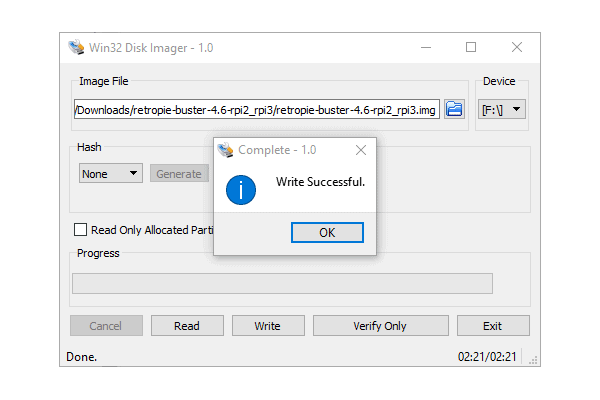
- Select the ISO Image: Now Open the Win32 Disk Imager and select the ISO file which you want to write also select the Drive (USB Stick) from the option.
- Writing ISO Image: After selecting file path, click on the ‘Write’ button. A pop-up will appears simply click on ‘Yes’. After completing file transfer a Success pop up will appear and you will able to remove the USB Stick, Done!
Side by Side comparison of Win32DiskImager and Rufus
| Win32DiskImager | Rufus | Windows Media Creation tool | |
|---|---|---|---|
| Support OS (Platform on which application can run) | Windows | Windows | Windows |
| Can make Bootable Windows OS USB? | Yes | Yes | Yes |
| Can make Bootable Linux / Ubuntu USB? | Yes | Yes | No |
| Size of the application | 12.6 MB | 1.1 MB | 18.5 MB |
| Average time to make bootable USB | 7 sec | 4 sec | N/A |
| GPT/UEFI Support with NTFS UEFI Support | Yes | Yes | N/A |
| Multi-language support | No | Yes | No |
| How to check Hashes? | Manually using PowerShell | There is an option: “#” in bottom; just hit it! | MCT Download windows directly so less chances of corrupted ISO file |
| Multiboot available? | No | No | No |
Frequently Asked Questions
What does Win32 Disk Imager do?
.img, .iso, .bin) to USB drives and SD cards and can read them back to an image file for backup or cloning. It preserves boot sectors and partition layout for reliable, bootable media.
Will using it erase data on my USB/SD card?
Do I need Administrator rights?
How do I verify the installer is safe and intact?
What’s “Verify Image” and when should I use it?
Can it read back a card to an image for backup?
My drive isn’t listed or shows the wrong size—what should I do?
Why is the write speed slow?
Does it support .ISO files?
.iso images when they are raw-writable. If a specific ISO expects special handling, use the vendor’s method or convert to a raw image as advised by the distribution.